Choose an area rug’s dimensions from the furniture arrangement and the floor space you can actually use. Then mark the proposed footprint on the floor before ordering. A living room, bedroom or dining room label does not tell you which size will fit your layout.
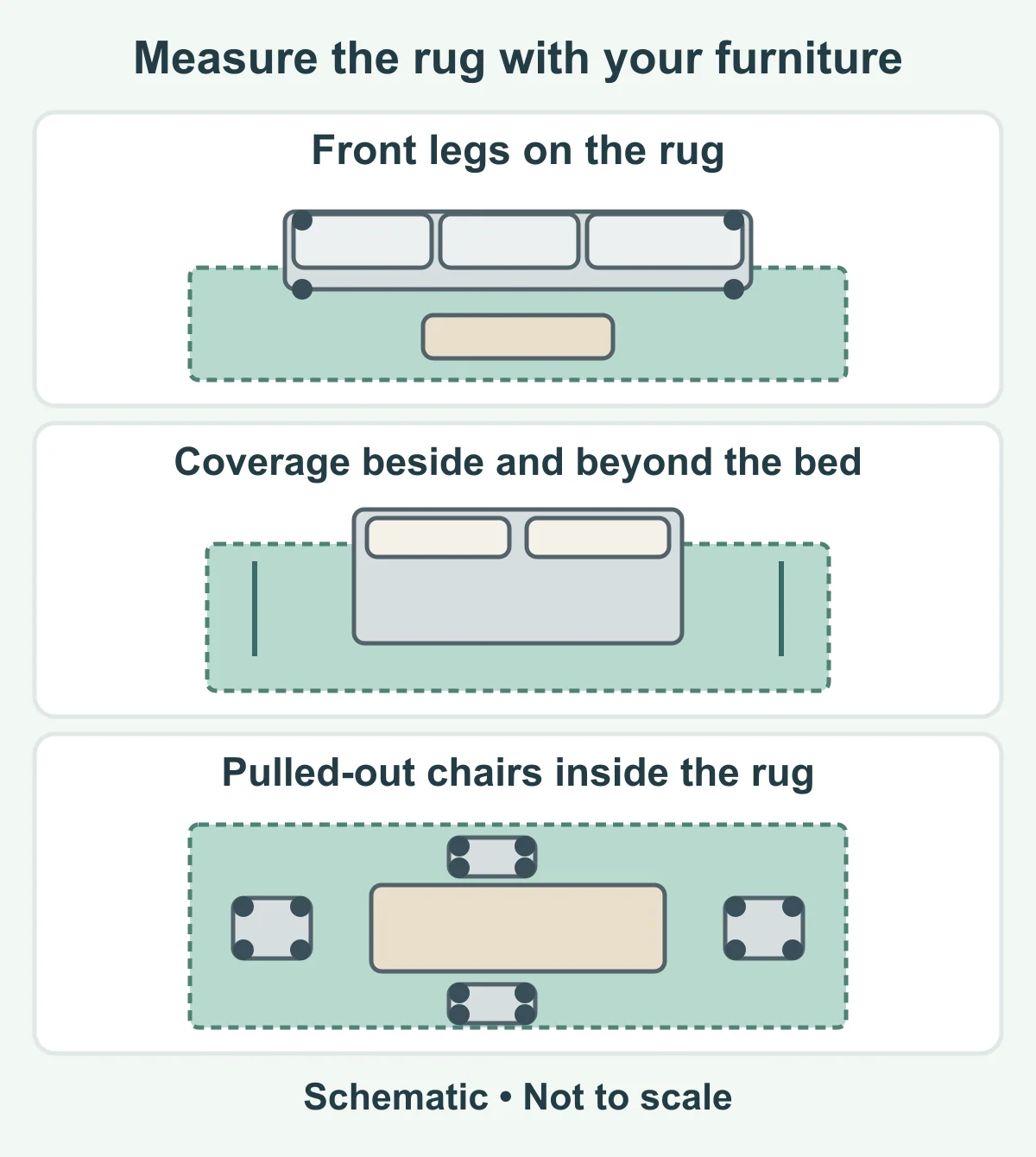
Front-leg and all-leg seating arrangements need different footprints. Bedrooms need coverage where people step beside and beyond the bed, while dining rugs need to accommodate chairs pulled out for sitting and standing.
Start with the space you can use
Measure the space with furniture in its intended position. Note doors, fixed units and the route people use through the room. Mark the rug’s width and length on the floor, then walk around the outline and move the furniture as you normally would. Adjust the footprint if it interferes with that use.
Choose a living-room seating arrangement
Decide whether the rug will sit under the front legs of the main seating or under all its legs. Measure the seating group as arranged, including a chaise or angled chairs; measuring only the sofa can miss part of the footprint.
For front-leg placement, mark an outline that includes the intended front legs of each main seat. For all-leg placement, extend it to include their rear legs too. Check that the arrangement leaves the walking route you need.
Measure coverage beside the bed
Use the actual bed frame, including any part that projects beyond the mattress. A queen or king label alone is not a reliable measurement for an international order. Mark the coverage you want beside the bed and beyond its foot.
Stand where you normally get in and out of bed to check the outline. If a larger rug does not fit the usable space, bedside runners offer another way to cover those stepping areas.
Measure dining chairs in use
Set the table in the configuration you intend to use. Pull each chair out far enough for normal sitting and standing, then measure the outline needed to keep its legs on the rug. Include the chairs at the ends of the table.
Check the remaining walking space around that outline. There is no fixed clearance that guarantees a suitable fit in every room; the table, chairs and daily movement must work together in your space.
Check a runner along its full length
Measure the narrowest usable section of the hallway, then mark the runner’s proposed width and length. Check door movement and the route through the hall along its full length. A named runner size is only a label; compare its actual dimensions with the footprint you have marked.
Keep feet and centimetres precise
One foot equals exactly 30.48 centimetres, as stated in NIST’s definition of the international foot. Multiply each dimension in feet by 30.48 to get centimetres, or divide centimetres by 30.48 to get feet.
| Dimensions in feet | Exact dimensions in centimetres |
|---|---|
| 6 × 9 ft | 182.88 × 274.32 cm |
| 8 × 10 ft | 243.84 × 304.8 cm |
| 9 × 12 ft | 274.32 × 365.76 cm |
These are exact conversions, not room-fit recommendations or confirmed stocked sizes. An 8 × 10 ft rug is not the same size as a 200 × 300 cm rug. Keep the requested unit and exact dimensions in your specification instead of substituting an approximate retail label.
Turn the measurements into a custom specification
Custom Carpet Maker’s maximum production width is 3 metres, and a 300 × 400 cm size can be discussed. The 3-metre figure refers to width, not maximum length. Confirm the construction, backing, finish and design for your order before assuming a size is available; it does not mean every product can be made in every dimension.
For bulk custom orders, the starting order quantity is 100 m². Sizes and patterns are discussed for each order. Reference photos can help explain the appearance you want, but they do not establish stock availability or guarantee a fit.
Send the following with your enquiry:
- Width and length, with the measurement unit clearly stated.
- The intended placement and pattern direction.
- A simple sketch showing the furniture and rug outline.
- The quantity required for each size.
After checking the footprint, compare area rug styles and review the custom order requirements. Before final approval, confirm the finished dimensions and the tolerances agreed for your order.