When sourcing prayer mats wholesale, start by matching the surface construction to your retail tier and artwork brief. Choose embossed Raschel for raised sculptural motifs and plush visual presence, digital printed surfaces when multi-colour architectural scenes or custom Ramadan and corporate gift artwork are the priority, and smooth velvet-style finishes for clean classical aesthetics. Lock finished body dimensions, fringe construction, edge trim, backing, and order volume before requesting a sample. Under a 100 m² factory starting order quantity, rectangular area math translates to at least 130 pieces at 70 × 110 cm or 105 pieces at 80 × 120 cm, though splitting that 100 m² across multiple patterns or shaped outlines requires per-order confirmation. This guide covers individual wholesale prayer mats rather than wall-to-wall mosque roll carpeting, and formats such as 70 × 110 cm and 80 × 120 cm are commercial reference sizes rather than a universal industry or religious standard.
Embossed Raschel, Digital Printed, and Velvet-Style Prayer Mats Compared
This buying guide compares three surface styles ordered by B2B wholesale buyers serving Saudi Arabia, the UAE, wider GCC markets, and global retail channels. Each behaves differently on display, carries different artwork strengths, and needs its own physical checks at sampling.
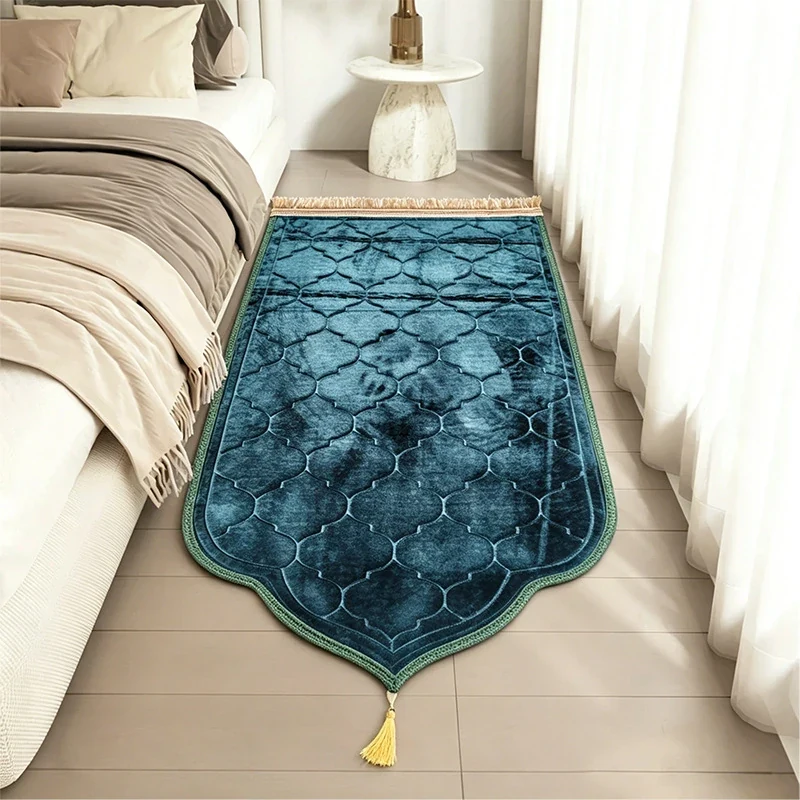
Embossed Raschel mats rely on raised relief patterns, typically mihrab arches, geometric medallions, or vintage floral borders, to give the mat visual depth and a fuller hand feel. In the wholesale prayer mats collection at Custom Carpet Maker, representative options include a rectangular embossed Raschel prayer mat style at a 70 × 110 cm reference size, a printed Raschel prayer mat style at 70 × 110 cm that layers colour detail onto sculpted relief, and vintage floral border Raschel formats at 80 × 120 cm. Because shoppers can read the carved relief from a shelf or hanging rack, these constructions suit retail chains, seasonal Ramadan assortments, and distributor catalogues where visual depth matters on display.
Digital printed surfaces shift priority from carved pile relief to graphic complexity. They fit custom corporate gifting, Umrah tour packs, architectural sanctuary prints, and seasonal designs that require sharp fine lines or multiple colours across one face. According to Zimmer Austria’s floor-covering digital printing technical overview, industrial digital carpet printing involves colour separation, calibration, jet printing, steaming and fixation, washing, dewatering, and drying. Because colour retention depends on how every step in that sequence is executed, a quotation labelled “printed” tells you very little on its own. Importers should always test dry and wet colourfastness and part the pile on a physical sample to check dye penetration before approving bulk output.
Velvet-style finishes take the opposite route. Rather than deep relief or busy multi-colour artwork, they offer a smooth, low-glare pile that suits solid tones, restrained classical borders, and traditional gift boxes. Both custom digital-printed and velvet-style finishes can be discussed per order alongside embossed Raschel lines. Keep in mind that photographs on supplier catalogues show representative styles rather than fixed ready stock or locked specifications; face material, pile feel, backing, dimensions, and fringe details are confirmed individually for each order.
| Buying Factor | Embossed Raschel | Digital Printed | Velvet-Style |
|---|---|---|---|
| Surface appearance | Raised sculptural motifs with soft pile relief | Flat or low-relief face built for crisp multi-colour detail | Smooth, even pile with a restrained classical look |
| Pattern flexibility | Strong tonal depth and embossed geometry; also combinable with surface printing | Highest flexibility for intricate architecture, logos, and custom gift artwork | Best suited to clean solid fields, subtle borders, and heritage palettes |
| Typical retail positioning | Core GCC retail shelves, souk wholesalers, and seasonal volume replenishment | Ramadan and Umrah campaigns, corporate gifts, and graphic collections | Traditional retail ranges and understated gift presentations |
| Key sample check | Motif definition, pile recovery after folding, and trim alignment | Dye penetration into pile base, shade accuracy, and colourfastness | Pile shading uniformity, crease recovery, and smooth-floor grip |
Translating a 100 m² Minimum Order Quantity into Piece Counts
Custom Carpet Maker supplies individual prayer mats for B2B wholesale and custom orders rather than single-piece retail orders or mosque roll carpeting, with bulk production starting at 100 m². Converting square metres into unit counts early helps purchasing teams align carton quantities, gift-box runs, and landed-cost spreadsheets before asking for a quotation.
By rectangular geometric area, a 70 × 110 cm prayer mat covers 0.77 m² (0.70 × 1.10 m), while an 80 × 120 cm mat covers 0.96 m² (0.80 × 1.20 m). Rounding up to meet or exceed 100 m² produces the illustrative piece counts below.
| Order Scenario | Reference Size | Area per Mat | Minimum Piece Count | Total Geometric Area |
|---|---|---|---|---|
| Standard rectangular | 70 × 110 cm | 0.77 m² | 130 pieces | 100.10 m² |
| Larger rectangular | 80 × 120 cm | 0.96 m² | 105 pieces | 100.80 m² |
| Mixed-size illustration | 70 pcs at 70 × 110 cm + 50 pcs at 80 × 120 cm | 0.77 m² / 0.96 m² | 120 pieces | 101.90 m² (53.90 m² + 48.00 m²) |
Treat these numbers as a geometric planning baseline rather than an automatic acceptance rule for mixed runs. Combining two sizes, multiple colourways, or different surface constructions inside one 100 m² minimum order quantity must be agreed with the factory per enquiry.
Two practical checks prevent quantity disputes later. First, shaped or pointed prayer mats cannot be calculated reliably from outer rectangular length multiplied by width; their settlement area has to be confirmed alongside the outline drawing. Second, always verify finished mat body dimensions separately from fringe length so your retail packaging and shelf labels match the received goods. For a full breakdown of commercial prayer mat proportions and measuring checkpoints, review the prayer mat size and measurement guide.
Construction Details Beyond the Surface Photo
Two prayer mats can look almost identical in an online thumbnail and still perform very differently once unpacked in a showroom. Leaving outline, edge, fringe, or backing details unspecified can trigger avoidable sample revisions even when the headline face pattern is already approved.
Fringe Attachment and Length Accounting
Not every fringe is constructed the same way. In textile classification as documented in The Textile Museum Thesaurus (George Washington University), fringes can be structural warp fringes, weft fringes, or separately applied fringes. That distinction directly affects seam strength, pulling resistance, and how the ends lie on the floor. Before sampling, state whether the fringe should be integrated or separately attached, specify yarn colour and length, and confirm whether fringe length is excluded from stated body dimensions. On a shaped fringed prayer mat style, also check the stitch anchoring of the pointed top tassel, since loose anchor threads fail quickly under retail handling.
Edge Binding, Serging, and Overlocking
Edge finishing protects the perimeter against fraying and frames the border motif. As outlined in the Union Special carpet overedging and binding machine technical overview, carpet and mat edges can be finished with tape binding, yarn serging, or overlocking and overedging stitches, used alone or in combination depending on machine setup and mat structure. Wholesale specifications should name the exact edge material and stitch finish rather than leaving it to factory default. Straight rectangular mats hold tension easily along all four sides, whereas pointed arches and scalloped outlines require careful stitch tension around curves so the border lies flat instead of cupping.
Backing Grip, Care Limits, and Specification Boundaries
In homes, offices, and prayer rooms with polished ceramic tile or stone flooring, backing friction varies by material, so test a physical sample directly on smooth tile rather than assuming uniform slip resistance across suppliers. Unquoted custom prayer mats do not carry fixed public figures for fibre blend percentages, piece weight in grams, foam-layer thickness, shrinkage, colourfastness grades, or anti-slip test scores; all of those metrics depend on the agreed construction and sample.
Care labelling also requires attention to the complete product. A washability statement on a face textile does not automatically mean a finished prayer mat with embossed pile, laminated backing, and fringes can withstand domestic machine washing. Confirm care instructions for the finished assembly before printing sewn-in labels or gift-box sleeves. In addition, buyers sourcing for institutional tenders or projects with strict building-code clauses should note upfront that Custom Carpet Maker does not provide fire-retardant treatments or fire-rated certifications.
Pre-Production Sampling, Packaging, and Ocean Transit Checks
Sampling is the cheapest point in the wholesale cycle to catch shade drift, weak fringe seams, or creasing issues. Custom Carpet Maker provides samples at retail prices, and that sample payment can be credited toward the buyer’s next bulk order, with international courier shipping quoted separately by destination.
When a pre-production sample arrives, evaluate it under the same physical conditions your customers will experience. Check colour consistency in daylight and indoor lighting, rub printed surfaces to inspect colourfastness, verify body measurements excluding fringes, test floor grip on smooth tile, and fold the mat under weight overnight to see whether embossed motifs recover cleanly. For a structured sign-off workflow covering colour tolerances and construction verification, see the rug sample approval guide.
Packaging and shipping format deserve equal attention during quotation because unit prices, custom polybags, rigid gift boxes, and production or transit lead times vary by specification. Folding or tight bale compression cuts freight volume, but high-relief embossed pile can hold deep crease lines if packed too aggressively. Moisture control matters just as much on sea routes into Gulf ports or humid coastal hubs. According to the ILO/IMO/UNECE Code of Practice for Packing of Cargo Transport Units (CTU Code), enclosing damp textiles in plastic film or exposing cargo to container condensation during ocean transit increases mould risk. Confirm complete post-production drying, inner polybag or moisture-protection choices, and master carton or bale packing methods with the factory before shipment.
GCC Import Compliance: Separating Saudi Arabia and UAE Requirements
When distributors selling across the Gulf consolidate prayer mat buying into one seasonal shipment plan, import conformity rules in Saudi Arabia and the United Arab Emirates still operate under separate national frameworks. Confirming destination documentation before bulk production avoids customs holds and relabelling costs at port.
Saudi Arabia: SASO Textile Regulation and SABER Certificates
In the official SASO Technical Regulations catalogue, Saudi Arabia’s Technical Regulation of Textile Products (Issue 2) was approved on 2023-12-28, published on 2024-01-12, and carries a listed mandatory application date of 2024-07-12. Importers should confirm the current HS code classification and labelling scope for their specific prayer mat construction with their customs broker or conformity body.
At the clearance stage, the Saudi SABER conformity platform separates Product Conformity Certificates from per-consignment Shipment Certificates. Buyers shipping to Saudi Arabia should verify that the product registration and Product Conformity Certificate are in place well ahead of completion, then arrange the Shipment Certificate for each individual consignment before dispatch.
United Arab Emirates: MoIAT Conformity Process
The United Arab Emirates manages regulated product conformity separately from Saudi Arabia through the UAE MoIAT conformity certificates service. A shipment cleared or documented under SASO and SABER does not automatically satisfy UAE regulatory workflows. Importers distributing into both Saudi Arabia and the UAE should check each country’s current regulated-textile documentation and label wording independently before finalizing sewn-in care tags or retail gift cartons.
Preparing Your Wholesale Prayer Mat Enquiry
Before opening price discussions or booking a sample, assemble a short specification sheet covering five items:
- State whether you need embossed Raschel, printed embossed Raschel, digital printed, or velvet-style surfaces, and attach visual references or artwork files.
- Specify the outline shape (rectangular or pointed) and confirm finished body dimensions separately from fringe length.
- Estimate total piece counts against the 100 m² starting order quantity, flagging any proposed multi-design, mixed-size, or shaped-outline split for factory confirmation.
- Define fringe attachment method, edge binding or overlocking finish, and the flooring type on which you will test the backing sample.
- Note retail packaging requirements (polybag, gift box, carton, or bale) and destination country so labelling, care wording, and ocean-transit moisture protection are aligned before sampling.
With those details confirmed, you can request a wholesale prayer mat quote and move directly to a targeted sample without wasted revision rounds.