A door mat fits only when its width and depth suit the clear floor space and the door can move over its full finished thickness. A standard-size label does not establish either. Measure the intended position, check the smallest door-to-floor gap wherever the door crosses the mat, and confirm the fit with a sample before agreeing the finished specification.
What does “standard door mat size” mean?
Treat a listed size as a starting point for comparison. You still need the actual width across the doorway and the depth extending out from the threshold. Two dimensions alone do not tell you which way the mat will face, so label both directions on your sketch.
Custom Carpet Maker’s Jacquard Tufted Door Mat (RG-008) and Flocked Tufted Door Mat (RG-014) each have a 50 × 80 cm reference size. That is a reference for these two styles, not a universal standard or a guarantee that either will fit your entrance. Sizes and patterns can be discussed for an order; you can compare the door mat styles before preparing your measurements.
Measure the floor space and the door swing
Start at the exact position where you want the mat. Measure the clear, level area there, keeping the proposed footprint clear of steps and obstructions. The available space elsewhere in the entrance may be larger, but it does not establish fit at your chosen position.
- Measure the width across the doorway. Mark this direction as “width” on the sketch.
- Measure the depth out from the threshold. Mark this direction as “depth” and show where the mat begins.
- Mark the door’s opening arc and the part of the proposed mat that falls beneath it. This is the area where vertical clearance also needs checking.
When considering the 50 × 80 cm reference, state which dimension you intend to place across the doorway. Reversing the orientation changes how far the mat extends from the threshold and which part of it lies under the moving door.
A paper outline can help you compare the proposed footprint with the floor area and adjust its position. It cannot tell you whether the door will clear the mat: paper does not represent the mat’s finished thickness.
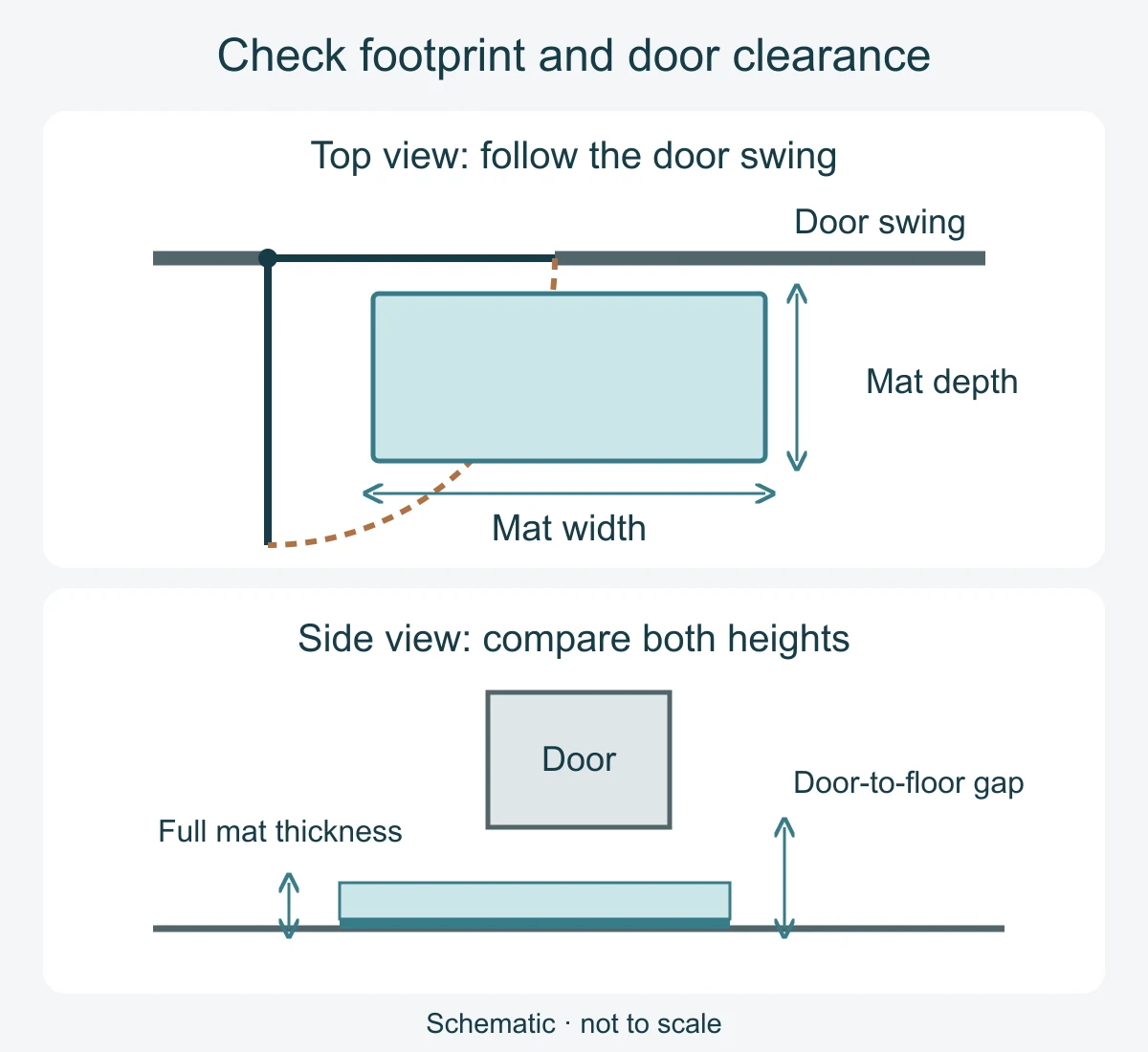
Compare full mat thickness with door clearance
Floor fit and door clearance are separate checks. A mat can sit entirely within the available floor area yet still catch the bottom of the door.
Measure the door-to-floor gap throughout the part of the opening arc above the proposed mat. Include the lowest sweep or seal, if present, and identify the smallest available gap along that path. A measurement at the threshold alone does not establish clearance throughout the door’s movement.
Compare that gap with the actual finished mat’s full thickness, including its backing and edges. Ask for the thickness of the specification you are considering; the reference width and depth do not provide this information. There is no verified universal millimetre allowance for these two styles that can replace the measurements at your entrance.
Confirm the comparison with a sample laid flat at the intended position. Open the door slowly through the full movement you need to use. If it catches, drags on the mat or folds an edge, that placement and specification have not passed the fit check.
What can change if the footprint fits but the door catches?
Keep the two findings separate: the footprint may fit while the clearance check fails. Reducing width or depth only helps if the revised footprint changes where the mat sits in relation to the door’s path. A smaller mat can still catch if the door passes over it.
One option is to consider a position outside the opening arc. Another is to discuss a different finished specification, including backing or edge finish, and check its actual thickness. Neither change establishes fit by itself; repeat the clearance check with the proposed mat at the proposed position.
For a position outside the door’s path, also check the available floor space, suitability of the material for that location and any shared-entry rules. Keep the mat clear of steps and obstructions when deciding where it can go.
What to send with a size enquiry
Give the supplier enough information to understand both the floor space and the moving door. A labelled sketch is more useful than a pair of dimensions without orientation or placement.
- A sketch showing the requested width across the doorway, depth from the threshold, measurement units and intended mat position.
- The door’s opening direction and arc, with the smallest measured gap above the proposed mat area, including any lower sweep or seal.
- The style and requested finish, with a request to confirm full finished thickness including backing and edges.
- The quantity for each requested size or pattern combination and the total order area.
- Any sample-fit observations, including where the door catches, drags or folds the mat.
Custom Carpet Maker serves business orders starting at 100 m². Dimensions, backing, finish, variation and requested combinations are confirmed per order, so include the full size mix in your enquiry.
For a business order, send your mat dimensions with the labelled sketch, requested combinations and quantities. Ask for the full finished thickness and discuss how to check a sample at your entrance before agreeing the final size and specification.