Buy from a regional wholesale hub such as Dubai when you need immediate stock, small mixed quantities, or standard market designs you can inspect on the floor. Source directly from a China rug factory when your business requires custom dimensions, private-label artwork or brand logos, consistent repeat runs, or a lower landed unit cost at bulk volume. Direct bulk ordering with Custom Carpet Maker covers individual area rugs, prayer mats, door mats, kitchen mats, and bath mats and sets rather than wall-to-wall broadloom carpet. Orders start at 100 m² with a 3-metre maximum production width, and physical samples are charged at retail prices with the sample payment credited toward your next bulk order. A lower ex-factory quote does not automatically deliver a lower landed cost, because backing weight, packing volume, sea freight, and destination conformity checks all affect the final figure.
When China Factory-Direct Beats Regional Wholesale Hubs
Regional re-export hubs and Chinese factories solve different purchasing problems. Wholesalers in Dubai or similar regional trading centres hold finished inventory across common sizes and fast-moving patterns, which removes production wait times and lets buyers pick up mixed cartons in a single trip. That model works well for urgent restocking, seasonal gap filling, or testing consumer appetite before committing capital to a production run.
Direct factory manufacturing wins once specifications matter more than next-week availability. If a retail chain needs exact room dimensions, a brand wants exclusive colourways printed with its own mark, or an importer needs a repeat shipment six months later to match the first lot in pile feel and backing, open-market stock rarely holds steady. Regional traders also build their own warehousing, financing, and resale margins into each piece, which widens the gap on repeat bulk orders.
| Decision Factor | China Factory-Direct | Regional Wholesale Hub (e.g., Dubai) |
|---|---|---|
| Best commercial use case | Private-label lines, custom sizes, logo mats, repeat bulk replenishment | Urgent fill-in orders, small mixed assortments, rapid market testing |
| Inventory status | Made to order against confirmed specifications | Ready stock available for immediate inspection and dispatch |
| Design and logo control | Custom artwork, digital print patterns, brand labels, and matched sets | Limited to patterns and colourways already held by traders |
| Sizing and backing control | Confirmed per order within factory equipment limits | Fixed to pre-manufactured dimensions and existing backings |
| Order entry threshold | Bulk square-metre minimum (100 m² at Custom Carpet Maker) | Small lot or per-bale buying, which can carry higher unit markups |
| Repeat-order consistency | Tied to a retained master swatch and written specification sheet | Dependent on whether the hub re-orders the same mill batch |
| Main landed-cost variables | Ex-factory price, freight cubic volume, duties, and destination certificates | Trader markup plus regional transport and local clearance |
Price comparisons between the two channels break down quickly when buyers compare different constructions. A regional wholesale rug may weigh less per square metre, use a thinner backing, or come folded in compressed bales, while a factory quote may price rolled packing and a heavier anti-slip base. Compare the full landed cost per square metre for the exact same face material, backing, edge finish, packing format, and customs clearance requirement before choosing a channel.
Separating Genuine Rug Factories from Trading Intermediaries
Many online listings present showroom photos as factory output. Before sending proprietary artwork or wiring a deposit, check how a supplier answers technical questions about production limits, coloration, and exclusions.
Start by reading product photography carefully. On a custom manufacturer’s site, such as our wholesale area rugs catalogue, displayed rug images show styles the workshop can produce rather than ready stock sitting in fixed sizes with preset specifications. A genuine factory will ask for your target size, backing, edge finish, and application before quoting, instead of claiming every photographed rug is immediately available in every dimension.
Next, test whether the supplier understands how carpet manufacturing separates structure from colour. As explained in The Carpet and Rug Institute’s Carpet Primer, coloration stage (such as solution-dyed, yarn-dyed, piece-dyed, or post-printed) and structural construction are separate dimensions of carpet production. When a sales contact treats a print look or fibre name as a full technical specification, you are likely dealing with a middleman who lacks line-level control.
The same check applies to custom printed rugs and logo mats. According to Zimmer Austria’s floor-covering digital printing technical overview, industrial digital carpet printing is a full-line process involving colour separation, colour calibration, jet application, steaming or fixation, washing, dewatering, and drying rather than printhead output alone. Naming a printing machine or saying “digital print” does not prove colourfastness or dye penetration on its own. Ask which substrate the factory prints on, how artwork files should be prepared, and what the finished sample looks like under normal lighting.
Finally, listen for clear boundaries. Factories know what their lines cannot run. Custom Carpet Maker handles B2B bulk orders for individual rugs and mats—area rugs, prayer mats, door mats, kitchen mats, and bath mats and sets—and does not manufacture wall-to-wall broadloom carpet, commercial aluminium-frame entrance matting, or pure rubber entrance systems. A supplier that claims it can produce every commercial flooring system under one roof may be outsourcing part of the order.
Planning Bulk Orders Around a 100 m² MOQ and 3-Metre Width Limit
Bulk rug factories plan production by square metres and machine width rather than piece count alone. Understanding those two constraints early prevents rework after artwork is already designed.
At Custom Carpet Maker, bulk orders start at 100 m². Converting a piece list into total area is straightforward: multiply length by width in metres, then multiply by piece quantity. Our rug order area calculation guide walks through mixed size sheets in detail, and three quick examples show how piece counts scale:
- Area rug at 200 × 300 cm (6.00 m² each): 17 pieces reach 102.00 m².
- Prayer mat or door mat at 80 × 120 cm (0.96 m² each): 105 pieces reach 100.80 m².
- Oversized living-room rug at 300 × 400 cm (12.00 m² each): 9 pieces reach 108.00 m².
How many designs, sizes, and piece quantities can be split inside a single 100 m² order depends on the construction, backing, and print setup, so multi-SKU splits must be confirmed per enquiry. Grouping SKUs that share the same face material and backing generally makes production planning easier than mixing unrelated product families in a minimum-size order.
Width is the second hard boundary. Custom Carpet Maker’s maximum production width is 3 metres (300 cm). That figure sets the production width cap rather than a fixed 3-metre length cap, which is why large individual formats such as 300 × 400 cm can be discussed per order. Even so, a 3-metre width limit is not an unlimited sizing promise across every textile or backing. Narrow runner sets, contoured bath mats, and thick door mats each carry their own cutting and edging constraints that need confirmation against your exact layout.
Building an Apples-to-Apples Custom Rug Specification Sheet
Vague enquiries generate unusable quotes. Asking three factories for “a 200 × 300 cm printed living-room rug” will return three prices built on different substrates, backings, edge bindings, and packing methods. Putting the core variables into a single specification sheet forces every supplier to price the same product.
| Specification Area | Details to Fix Before Quoting | Why Omitting It Distorts Quotes |
|---|---|---|
| Product category and dimensions | Individual rug or mat type, exact width and length in cm, and piece count per size | Confirms eligibility within the 3-metre width cap and 100 m² starting area |
| Face construction and coloration | Target textile feel, pile profile, and whether colour comes from dyed yarn or digital printing | Changes raw material cost, surface definition, and wash durability |
| Backing and floor contact | Backing type suited to tile, wood, or bathroom moisture, plus expected grip | Backing drives weight, shipping cost, and slip behaviour |
| Edge finish | Overlocking, folded hem, binding tape, or clean-cut finish matched to mat type | Affects labour time, fray resistance, and visual grade |
| Artwork and print setup | High-resolution pattern or logo files, colour references, and placement margin | Printing method and artwork suitability vary by textile surface |
| Care and performance claims | Intended cleaning method and whether end buyers expect specific test claims | Avoids false assumptions about machine washing, slip ratings, or fire ratings |
| Export packing and freight terms | Rolled vs. folded packing, polybag or retail sleeve needs, and destination port | Determines carton or bale volume and whether sea freight quotes match |
Pay particular attention to care and performance language. A face fabric described as washable does not automatically mean the finished rug or mat is machine washable, nor does it establish verified slip-resistance or fire-performance ratings. Care instructions depend on the complete combination of face material, backing adhesive or latex layer, and edge binding. If you are weighing substrate choices before drafting your sheet, review our guide to comparing rug materials and backings.
Expect pricing, production lead times, custom retail packaging, and international freight terms to be confirmed per order. Ex-factory square-metre prices, standard carton sizes, pallet weights, and transit schedules shift with style, backing, quantity, and destination, so treat any flat online price list for custom rugs with caution until your exact specification is quoted.
Sampling, Quality Inspection, and Moisture-Safe Export Packing
Once specifications are aligned on paper, physical verification and export handling protect your margin from three recurring direct-import risks: colour drift, inconsistent bulk finishing, and transit mould.
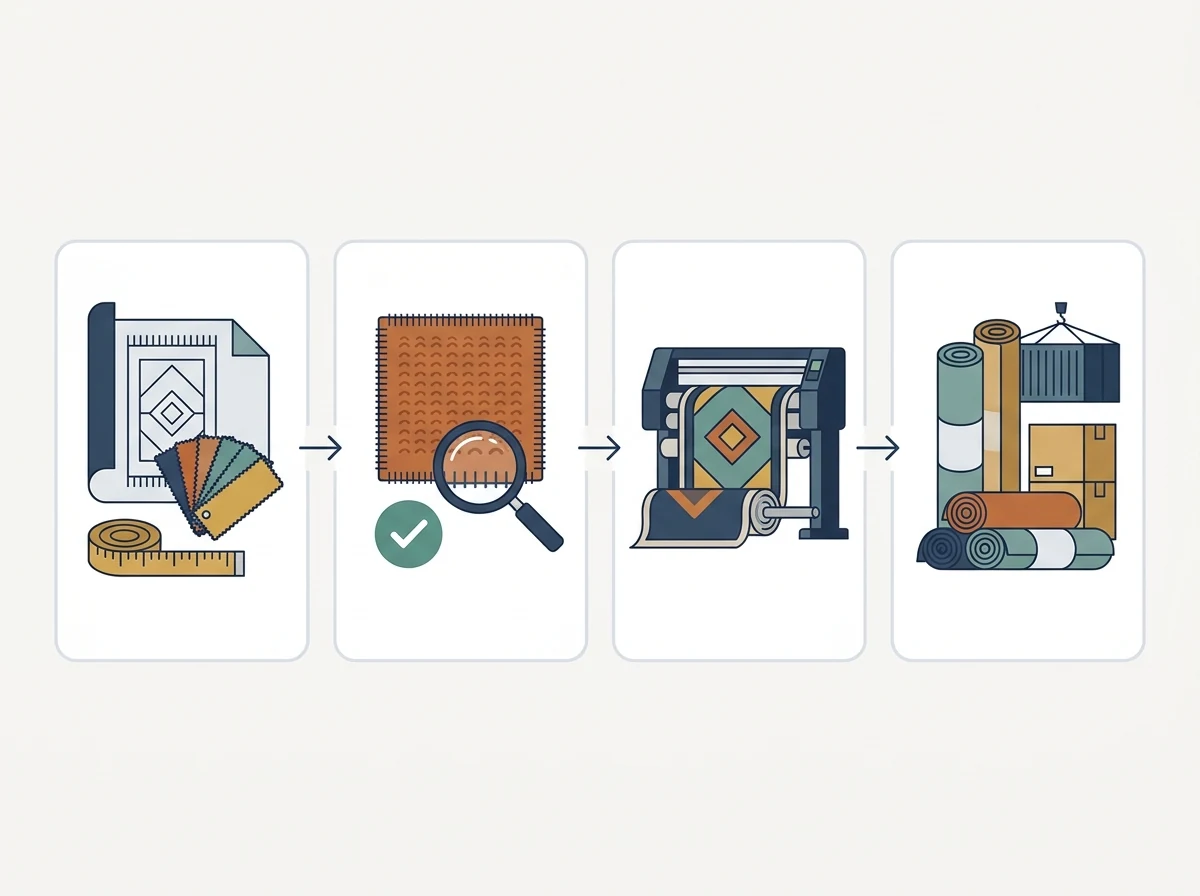
Locking Specifications with Retail-Priced Samples Credited Toward Bulk Orders
Skip straight to bulk production only if you are willing to absorb surprise shade shifts or backing stiffness. At Custom Carpet Maker, physical samples are available at retail prices, and the sample payment can be credited toward your next bulk order. International courier freight for samples is quoted separately based on your destination and chosen shipping service.
Treat the approved physical piece as your contract benchmark. Retain one signed reference swatch on your side and leave an identical reference swatch with the factory, a standard practice noted in The Carpet and Rug Institute’s Carpet Primer for checking production consistency. Before releasing the bulk deposit, inspect pattern sharpness, edge straightness, backing odour and flexibility, and flat-lay recovery after unrolling. You can follow our rug sample approval checklist alongside the custom rug and mat order process to keep sign-off steps documented.
Setting Realistic Pre-Shipment AQL Checks
Pre-shipment inspection catches packaging mistakes, wrong size labels, visible print flaws, and backing defects before the container leaves port. Buyers use Acceptable Quality Limit (AQL) sampling tables for this check, yet it is easy to misread what a “pass” result actually means.
As outlined in the NIST Engineering Statistics Handbook on acceptance sampling, acceptance sampling plans decide whether to accept or reject a production lot based on an inspected sample and always carry statistical sampling risk. Passing an AQL inspection does not guarantee that every single rug inside an accepted shipment is defect-free.
Make inspection more effective by defining defect categories before production starts rather than on inspection day. Specify what counts as a critical defect (wrong logo, damp odour, severe backing delamination), a major defect (noticeable colour shift from the master swatch, broken overlocking, dimensions outside agreed tolerance), and a minor defect. Remember that exact colourfastness grades, dimensional tolerances, fibre blend percentages, and backing adhesion reports do not exist by default on custom runs unless agreed and tested for the specific product.
Preventing Mould and Damage in Containerised Sea Freight
Rugs and textile mats travel poorly when moisture is trapped inside sealed ocean containers. According to the ILO/IMO/UNECE Code of Practice for Packing of Cargo Transport Units (CTU Code), temperature swings during sea voyages, container condensation, damp dunnage, and wrapping moist cargo tightly in plastic film can all raise the risk of mould and moisture damage.
Plastic polybags or stretch wrap alone do not prove moisture protection, nor do they secure rolls against shifting inside a container. Confirm that finished rugs are thoroughly dried after washing or printing before packing, check that cartons and wooden pallets (if used) are dry, agree on desiccants where route humidity warrants them, and verify whether rolled or folded packing better protects your backing from permanent creasing.
Destination Compliance and Market Restrictions to Verify Before Production
Customs clearance and product-safety rules vary sharply across GCC, European, and North American markets. Checking those requirements after production starts is one of the fastest ways to trap a container at the destination port.
For shipments entering Saudi Arabia, review the SASO Technical Regulations catalogue, which lists the Technical Regulation of Textile Products (Issue 2) as approved on 2023-12-28, published on 2024-01-12, and carrying a mandatory application date of 2024-07-12. Importers must confirm HS code coverage and current applicability for the exact rug or mat category before shipping. Clearance also runs through the Saudi SABER conformity platform, which separates Product Conformity Certificates from per-consignment Shipment Certificates. Holding a SABER account or an older product certificate does not replace shipment-level verification for each incoming consignment.
Buyers distributing across the wider Gulf should not assume one GCC certificate covers every country. The United Arab Emirates manages regulated textile products separately through the UAE MoIAT conformity certificates service. If your business ships to both Riyadh and Dubai, verify each country’s active conformity rules, labelling language requirements, and importer-of-record obligations independently before booking production.
Check fire-performance boundaries at the same stage. Custom Carpet Maker does not offer fire-retardant carpet treatments or fire-rated certifications. If your order is destined for commercial contract projects, hospitality corridors, or retail tenders that legally require certified fire-retardant test reports, do not place the order with a non-fire-rated rug supplier; confirm certification eligibility before paying for samples.
Preparing Your First Direct Factory Enquiry
Direct sourcing from China pays off when your order crosses the 100 m² threshold and your business gains commercial value from exclusive patterns, private-label branding, custom sizing within the 3-metre width limit, or consistent repeat lots. If you only need twenty assorted rugs next week, a regional wholesale hub remains the practical choice.
Before asking for a factory quote, assemble five concrete items: your target product category (area rugs, prayer mats, door mats, kitchen mats, or bath mats and sets), a size-and-quantity table totalling at least 100 m², reference photos or print-ready artwork, preferred face feel and backing needs, and your destination port along with any required market compliance checks. When those details are ready, you can request a custom bulk quote or sample and confirm unit pricing, SKU splitting, sample courier cost, and production lead time against your exact specification.