For rectangular rugs or mats, divide each dimension in centimetres by 100 to convert it to metres. Multiply the length by the width, then multiply by the number of pieces. Calculate each size separately and add the line totals.
Total rectangular area in m² = length in m × width in m × piece quantity.
This gives the geometric area of the pieces. The supplier still needs to confirm the quotation basis and whether the requested combination of designs, sizes and quantities can be accepted.
Converting centimetres to square metres
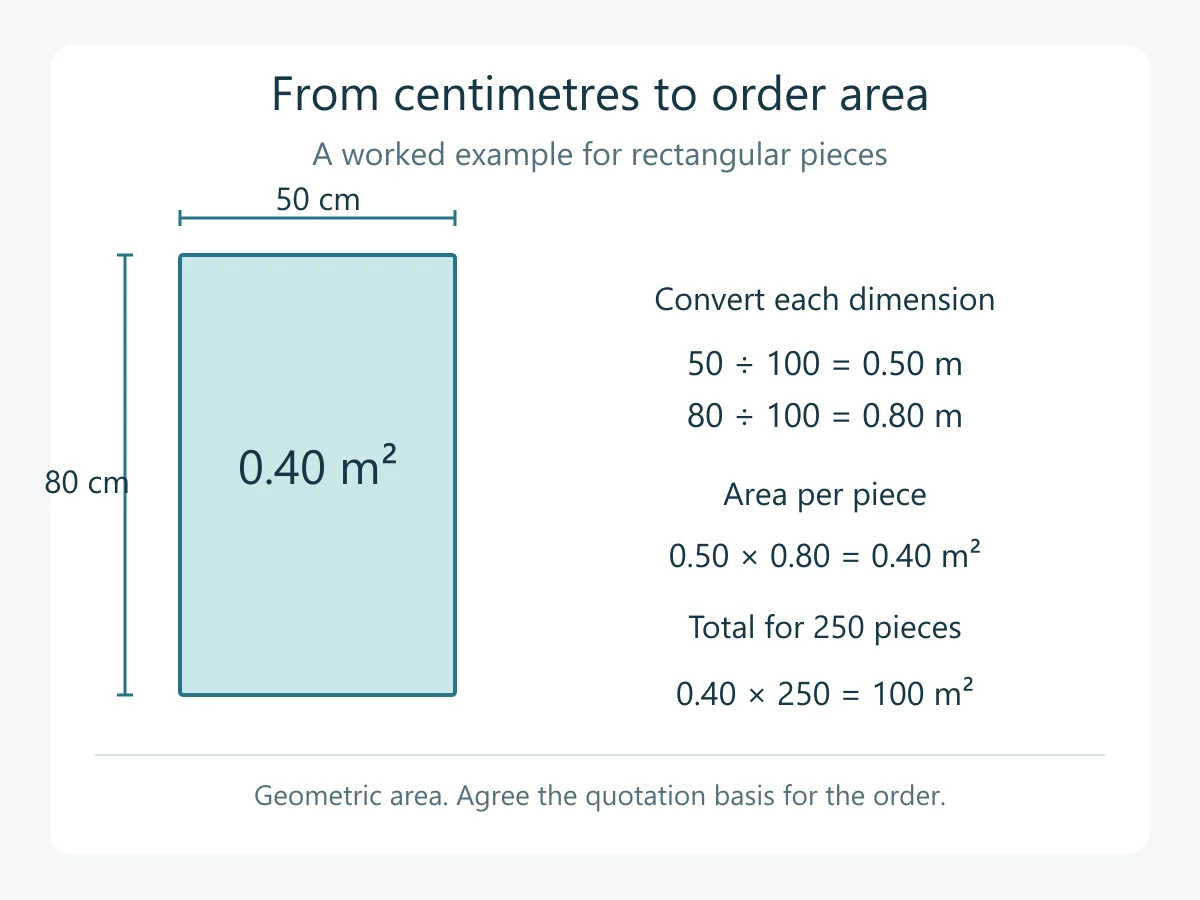
Both dimensions must use the same unit before multiplication. Since 1 m equals 100 cm, a rectangular piece measuring 50 × 80 cm becomes 0.50 × 0.80 m:
0.50 × 0.80 = 0.40 m² per piece.
For 250 identical rectangular pieces:
0.40 × 250 = 100 m².
You can also calculate in centimetres first: 50 × 80 = 4,000 cm². The conversion for area is different from the conversion for length: 1 m² equals 10,000 cm², so divide 4,000 by 10,000 to obtain 0.40 m². Dividing square centimetres by 100 would give the wrong result.
Different sizes in one request
Keep each size and its quantity on a separate line. This makes the calculation easier to check and avoids applying one piece size to the whole order.
| Rectangular piece size | Area per piece | Piece quantity | Line total |
|---|---|---|---|
| 50 × 80 cm | 0.40 m² | 100 | 40 m² |
| 40 × 60 cm | 0.24 m² | 250 | 60 m² |
The arithmetic total is 40 + 60 = 100 m². Reaching that total does not assure acceptance of this mixed-size request.
Two- and three-piece sets
For a set, calculate every component separately, including how many of each component the set contains. Add those areas to find the area per set, then multiply by the number of sets.
The following sets are hypothetical calculation examples, not named product configurations.
- Two-piece set: one 50 × 80 cm rectangle and one 40 × 60 cm rectangle give 0.40 + 0.24 = 0.64 m² per set. An order of 100 such sets has 64 m² of geometric area and contains 200 pieces.
- Three-piece set: one 60 × 90 cm rectangle, one 40 × 60 cm rectangle and one 30 × 40 cm rectangle give 0.54 + 0.24 + 0.12 = 0.90 m² per set. An order of 100 such sets has 90 m² of geometric area and contains 300 pieces.
If a set contains several pieces of the same size, multiply that component’s area by its quantity within the set before adding it to the other components. Multiplying the largest piece’s area by the total piece count gives the wrong answer when the sizes differ.
Curved and cut-out pieces
Maximum length × maximum width describes the rectangle that encloses a shaped piece. It does not give the exact area within a curved or cut-out outline.
Send the outline and dimensions to the supplier and agree how shaped pieces will be quoted and settled. Keep that agreed basis separate from the geometric calculations for rectangular pieces.
What to send for a quotation
Custom Carpet Maker supplies individual rugs and mats for business orders, with a starting order quantity of 100 m². For a particular order, the supplier must confirm the designs, sizes and piece quantities included in a combination, the finished dimensions and permitted variation, and the quotation basis. The custom order information explains the supplier’s current enquiry and specification requirements.
In your enquiry, list each style or outline, its dimensions with units, and the piece quantity. For sets, give the complete contents of each set and the number of sets. Include the geometric line totals and the destination.
An arithmetic total alone does not establish the price, waste allowance, permitted variation or acceptance of a mixed-style order. When those details are ready, send your order enquiry with the calculations so the supplier can review the request.